


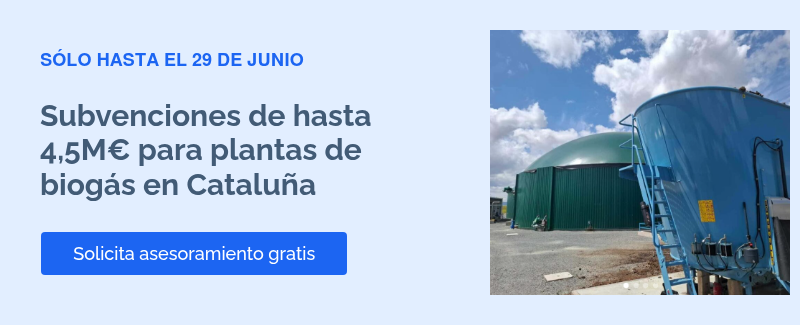
The Catalan government has just launched a call for grant applications to improve and optimize biogas facilities and treat the resulting digestate. With a total budget of €25 million and an application deadline of June 29, 2026 , this call represents a real opportunity for livestock farmers, agri-food industries, and organic waste managers who want to take the step towards energy recovery from their waste.
In this article we explain exactly what the aid covers, who can apply for it, how applications are assessed, and what steps to take to avoid missing the deadline.
What is the ARP/1258/2026 Call for Biogas in Catalonia?
The call for proposals, published under the ACC/250/2023 and ARP/1258/2026 terms, aims to subsidize the construction of biogas plant facilities and the treatment of the digestate produced in those plants.
The key data points are:
- Total budget: 25.000.000 €
- Application submission deadline: From April 29 to June 29, 2026
- Maximum execution time: until the 30 of June of 2028
- Help type: grant awarded on a competitive basis (all applications are assessed and compared)
- It's not minimal aidThis expands the possibilities for companies that have already exhausted other limits of public aid.
Biogas is produced from the anaerobic digestion of organic matter: livestock manure, crop residues, waste from the agri-food industry, municipal organic waste (OFMSW), and animal by-products. The result is renewable energy and a digestate that, when properly treated, can be used as fertilizer.
Who can apply for these grants?
The following may be beneficiaries of the call for proposals:
- Natural or legal persons of a private or public nature
- Groups and joint ownership communities without legal personality
- Consortia and public-private partnerships
The determining factor is not the legal structure, but the activity. The call for proposals is aimed at those who process livestock manure mixed with other organic co-substrates to transform it into biogas, or those who wish to process the resulting digestate.
In practice, the most relevant profiles are:
- Livestock farmers with large volumes of manure (slurry, manure), especially in areas with high livestock density such as those in Catalonia
- Agri-food industries with organic waste that can be co-digested
- Organic waste managers and plants that work with FORM from selective collection
- Existing biogas plants that work but do not have a digestate treatment system installed
An important technical requirement: the project must include at least 50% livestock manure in the co-substrate mix to access Action 1.
What actions does the call for proposals fund?
The call for proposals is divided into two independent but complementary lines of action. Both can be requested in the same project.
Action 1 — Improvement and expansion of biogas facilities (up to €3,5M)
It finances the optimization and expansion of existing biogas production facilities. Eligible items include:
- Co-substrate storage system (plant materials, slurries, etc.)
- Co-substrate pretreatment system
- Mixing tank
- Digesters and installation of safety elements
- Piping, valve, and pump systems
- Measurement and control systems
- Gasometer
- Biogas energy utilization facilities (cogeneration boiler or engine)
- Covered digestate storage system to prevent ammonia emissions
The maximum eligible percentage is 35% of the eligible budget , which can be increased by an additional 10% if part of the biogas is supplied to energy communities, isolated gas networks, captive vehicle fleets or industries.
Action 2 — Digest treatment facilities (up to €1M)
It finances the treatment of digestate produced in biogas plants, both new (subsidized by Action 1) and existing. Eligible expenses include:
- Separation of the solid and liquid fractions of the digest
- Composting
- drying
- Desorption (stripping) and absorption
- Membrane separation: ultrafiltration and reverse osmosis
The maximum eligible percentage is 40% of the eligible budget , with an additional bonus of 5% if the investment is located in an assisted area.
Additional bonuses based on company size
In both actions, the eligible percentage may increase:
- + 20 % for small businesses
- + 10 % for medium-sized businesses
This means that a small business applying for both actions can receive up to 55% subsidies on its investment , with a maximum total amount of 4,5 million euros.
Evaluation criteria: what scores higher
The application process is competitive, meaning all applications compete against each other and are ranked by score. Understanding the criteria allows you to assess your position before applying.
| Criterion | Points |
|---|---|
| Percentage of livestock excrement greater than 60% by weight | 10 pts |
| Environmental license initiated before the application | 10 pts |
| Joint project that includes Action 1 and Action 2 | 10 pts |
| Small business status | 10 pts |
| Location in an area vulnerable to nitrate pollution | 5 pts |
| Frequent supply of slurry (contract or accredited commitment) | 5 pts |
Maximum score: 50 points. A project that combines both actions, is from a small company, has more than 60% livestock waste, and has the environmental license in process can approach the maximum without too much difficulty if the actual situation allows it.
How SITRA can help you throughout the process
At SITRA, we have years of experience designing, building, and operating biogas plants and digestate treatment systems. This accumulated experience throughout the entire cycle—from engineering to operation and maintenance—gives us the technical authority to advise you on how to optimize your facility and make the most of this opportunity.
What we do in each phase:
Preliminary Analysis and Guidance: We analyze your current situation: available waste volumes, existing infrastructure, location, and company profile. Based on this information, we can advise you on suitable actions, a reasonable budget, and your approximate score based on the evaluation criteria.
Engineering and technical documentation: We help you prepare all the necessary technical documentation for your application: plans, construction details, calculations, and justification of eligible expenses. All materials are designed for independent technical review and approval. A well-documented application is one of the key factors that distinguishes projects from one another in a competitive funding round.
SITRA covers all eligible expenses for both projects. For measurement and control, we use WIM, our proprietary process automation and control tool . WIM monitors the installation's performance in real time, automates key processes, and allows for reduced operating costs and anticipated incidents—all from a centralized platform. For the remaining eligible expenses:
- Optimization of digesters and storage systems
- Installation and improvement of pretreatment systems
- Complete digestate treatment lines: phase separation, membranes, stripping, drying
Support throughout the project: Once the grant is awarded, we are the same company that carries out the installation. There is no change of contact person, no coordination between consultant and construction company. The team that guided you through the application process is the same one that implements the improvements.
If you want to know if your company can benefit from this funding opportunity and how to maximize the amount you can receive, schedule a free consultation with our team. We'll give you a detailed assessment in 30 minutes.
→ Request your free consultation.
The application period closes on June 29, 2026. If you need time to prepare technical documentation, start as soon as possible.
FAQ
Can I apply for the grant if I already have an operational biogas plant?
Yes. Action 2, aimed at digestate treatment, is open to both new plants (subsidized under Action 1 in the same call for proposals) and existing biogas plants that wish to add or improve their digestate treatment system. If your plant already produces biogas but does not adequately treat the resulting digestate, this is precisely the action designed for you.
What happens if I don't have the environmental license when I submit the application?
You can submit the application without having received the environmental license. However, having already started the process (that is, having submitted the application before the submission deadline) grants you 10 additional points in the evaluation criteria, which can be decisive in a competitive application. If you haven't started the process yet, it's one of the first steps you should take.
Is the biomethane upgrading equipment subsidized?
No. Upgrading equipment to transform biogas into biomethane is expressly excluded from the eligible concepts of Action 1. The call finances the use of biogas in the form of electrical or heat energy (boiler, cogeneration engine), not the purification for injection into the network.
How much time do I have to execute the project once the grant has been awarded?
The maximum period for carrying out the actions and submitting the justification is two years from the end of the application period, that is, until June 30, 2028. This is a reasonable timeframe for projects of this scale, but it is advisable to plan the engineering, bidding, and construction timelines carefully from the outset.
Can small farmers access this call for proposals or is it intended only for large companies?
The call for proposals does not establish a minimum company size. In fact, small businesses receive a bonus of up to 20 percentage points on top of the eligible percentage, giving them an advantage over larger companies. Groups and joint ownership entities can also apply, opening the door to cooperative projects among several livestock farmers in the same area who wish to share a common biogas plant.