
Suscríbete a nuestro blog y te enviaremos por email los nuevos artículos que publiquemos.
Suscribirme a la newsletter
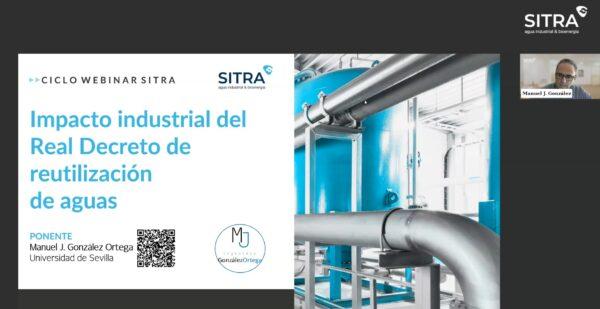
El pasado 30 de enero, desde SITRA organizamos un webinar donde analizamos el impacto industrial del nuevo Real Decreto de Reutilización de las Aguas. Durante la jornada, el ingeniero agrónomo y civil y docente en la Universidad de Sevilla, Manuel J. González; y la responsable del área de Operación y Mantenimiento de SITRA, Cristina Ferrer, abordaron puntos como la situación de la reutilización en España, los incentivos que podemos sacar de este reglamento para apostar por la reutilización a nivel industrial e incluso nos presentaron casos de éxito relacionados con esta práctica.
Al evento asistieron cientos de profesionales de diferentes sectores que preguntaron por diferentes cuestiones clave para su industria. Por ello, a través de este post vamos a recopilar todas esas preguntas para que puedas resolver todas tus dudas. ¡Vamos allá!
Infórmate con nuestros expertos sobre como le afecta este RD a tu empresa
¿Cómo debe actuar una empresa que actualmente ya tiene una concesión para reutilizar su propia agua depurada? ¿Cuáles son los plazos que tenemos para adaptarnos?
Según el Real Decreto 1085/2024, la fecha límite para las nuevas solicitudes de autorización de producción y concesión de uso de aguas regeneradas es, para los productores de agua regenerada para uso industrial (todo lo que no es agrícola), hasta el 31 de diciembre de 2025 para solicitar la autorización.
Si hablamos de usuarios, para los usos no agrícolas, estos deben solicitar la concesión o adaptar la autorización/concesión existente antes del 31 de diciembre de 2028, y es importante tener en cuenta que estos plazos son límites para iniciar los trámites de adaptación al nuevo reglamento:
- Autorización de producción y suministro (APS): Es solicitada por el operador de la estación regeneradora (ERA) y se centra en el Plan de Gestión del Riesgo del Agua Regenerada (PGRAR).
- La autoridad competente dispone de un plazo máximo de 12 meses para resolver la solicitud y las autoridades sanitarias tienen un máximo de 3 meses para emitir su informe.
- Concesión de reutilización (CRA): Es solicitada por el usuario del agua regenerada y se centra en la planificación hidrológica y su compatibilidad con los objetivos de dicha planificación.
- La concesión debe inscribirse en la Sección A del Registro de Aguas. En el caso de que el solicitante de la concesión sea el mismo que opera la estación regeneradora, ambos procedimientos (la concesión y la autorización de producción y suministro) pueden tramitarse simultáneamente.
Además, el nuevo reglamento establece que las autoridades competentes deben incluir y actualizar anualmente en el censo de vertidos autorizados, toda la información relacionada con las autorizaciones de producción y suministro de aguas regeneradas.
¿Qué tecnologías de regeneración cree que son las más adecuadas para el uso industrial?.
Para usos industriales con bajos requisitos (como refrigeración y procesos no críticos), es suficiente un tratamiento biológico avanzado combinado con filtración por arena y desinfección con cloro. Esto elimina eficazmente las bacterias y proporciona una barrera microbiológica económica.
En casos de mayor exigencia, como la industria agroalimentaria donde hay contacto indirecto con productos, se requiere una combinación más robusta:
- Ultrafiltración (UF) para eliminar sólidos finos y parte de los microorganismos.
- Luz ultravioleta (UV) para desinfección sin generar subproductos.
- Complementado con ozono o peróxido de hidrógeno para reducir materia orgánica.
Para la máxima exigencia (industria farmacéutica o electrónica), donde se requiere la eliminación total de patógenos, se implementa:
- Ósmosis inversa de doble paso
- Nanofiltración para retención de virus y protozoos
- Desinfección avanzada con ozono o UV de alta intensidad
Para alcanzar la calidad más alta (A+) en uso industrial, solo los sistemas de ultrafiltración (con poros de 0,04 y 0,1 μm) junto con UV son capaces de garantizar la eliminación efectiva de virus y protozoos. Para calidades menos exigentes (C o D), pueden ser suficientes los tratamientos fisicoquímicos tradicionales con desinfección básica.
Es importante tener en la cabeza el concepto de barreras múltiples: se puede usar agua de menor calidad si se implementan barreras adicionales de control que garanticen un nivel de riesgo equivalente. Esto permite flexibilidad en la selección de tecnologías mientras se mantienen los estándares de seguridad requeridos.
La clave está en adaptar el tren de tratamiento según el uso final específico, considerando tanto la eficiencia en la eliminación de patógenos como la viabilidad económica del proceso.
Algunos ejemplos posibles:
| Uso Industrial | Calidad Requerida | Tecnologías Clave | Ejemplo de Uso |
| Refrigeración, lavado y procesos no críticos | Baja o media (sin contacto directo con productos sensibles) | Tratamiento biológico avanzado, Filtración por arena, Cloro o hipoclorito sódico, Sistemas de oxidación química | Torres de refrigeración, limpieza de superficies en la industria |
| Industria agroalimentaria (contacto indirecto con productos) | Alta (sin patógenos, baja turbidez y buen control de contaminantes emergentes) | Ultrafiltración (UF), Luz ultravioleta (UV), Ozono o peróxido de hidrógeno, Carbón activo granular (CAG) | Lavado de maquinaria en la industria agroalimentaria, procesos de fermentación, uso en calderas de vapor |
| Industria farmacéutica y cosmética | Muy alta (ausencia de microorganismos y contaminantes químicos) | Ósmosis inversa (OI) de doble paso, Nanofiltración, Desinfección con peróxido de hidrógeno u ozono, Adsorción con carbón activo | Producción de cosméticos, fármacos, agua para formulaciones |
| Industria papelera y textil | Moderada (control de dureza y sólidos en suspensión) | Floculación y coagulación avanzada, Filtración por membranas (UF o NF), Electrodiálisis inversa (EDI), Desinfección con cloro | Producción de papel, industria textil con procesos de teñido |
| Industria electrónica y semiconductores | Ultrapura (eliminación total de sales y microorganismos) | Ósmosis inversa con pulido en resinas de intercambio iónico, Electrodesionización (EDI), Filtración por membranas de 0.01 micras, UV de alta intensidad | Fabricación de semiconductores y circuitos impresos |

¿El reglamento de reutilización es una oportunidad o una dificultad para el ámbito industrial?. ¿Qué desafíos pueden enfrentar las empresas para implementar el uso del agua regenerada?
El Reglamento de Reutilización del Agua (Real Decreto 1085/2024) marca un punto de inflexión en la gestión hídrica industrial, y sobre todo, es importante destacar la inclusión de la industria alimentaria en el nuevo reglamento. La premisa fundamental es que “el agua más cara es la que no se tiene”. Esta realidad se hace especialmente patente cuando las empresas dependen exclusivamente de fuentes convencionales para su desarrollo y operación, o incluso para su expansión.
Es interesante el uso de esta fuente de agua para permitir a las industrias diversificar sus fuentes de suministro, reduciendo la dependencia del agua convencional y los riesgos asociados a su disponibilidad. Muy importante para empresas que planean expandir sus operaciones, ya que la disponibilidad de agua regenerada puede facilitar el crecimiento sin depender de nuevas concesiones de agua convencional. Al optar por aguas regeneradas, las industrias pueden asegurar una fuente de suministro más estable y reducir su dependencia de fuentes convencionales.
Otro aspecto interesante, a la hora de mejorar la competitividad de las industrias y que viene reflejado en el nuevo reglamento es la introducción del Sello de Gestión Transparente del Agua, una certificación otorgada por la Secretaría de Estado de Medio Ambiente que reconoce a las empresas comprometidas con la gestión eficiente y transparente del agua regenerada.
Este distintivo puede convertirse en un valor diferencial significativo por dos aspectos principales: puede facilitar el acceso a licitaciones públicas donde la sostenibilidad sea un criterio de valoración, y puede abrir puertas a programas de ayudas y financiación destinados a promover la economía circular.
Desde un punto de vista económico, la regeneración puede resultar especialmente atractiva para industrias que actualmente pagan cánones elevados por el suministro municipal. Aunque la implementación de sistemas de regeneración requiere una inversión inicial considerable en infraestructura y tecnología, los costes de operación pueden amortizarse mediante el ahorro en tarifas de agua convencional y la reducción de cánones de vertido.
¿Qué entidad crees va a hacer de Observatorio del Agua?
Es muy probable que el Observatorio del Agua dependa del MITECO, específicamente de la Dirección General del Agua, ya que son quienes lideran la gestión hídrica a nivel nacional. También podría haber una coordinación con las confederaciones hidrográficas, que tienen un conocimiento más territorial. Además, con el impulso del PERTE del Agua, se han empezado a crear herramientas digitales, y la empresa NTT DATA ya está desarrollando plataformas para centralizar la información. Sin embargo, el reto no es solo técnico, también está en contar con funcionarios suficientes y capacitados para gestionar y analizar toda esta información.
Respecto a la calidad del agua para destino ambiental, la turbidez ha pasado de 2 a 5 NTU en recarga directa de acuíferos. Antes, 2 obligaba a usar ósmosis inversa (OI). ¿Por qué lo han subido?
El cambio de 2 a 5 NTU busca flexibilizar los requisitos y reducir los costes asociados a la implementación. Antes, con un límite de 2 NTU, era casi obligatorio usar ósmosis inversa, que es muy cara y tiene un alto consumo energético. Al permitir hasta 5 NTU, se pueden utilizar otras tecnologías más económicas, como ultrafiltración, sin comprometer la seguridad. Además, esta decisión está alineada con un enfoque más práctico y económico, donde se implementan barreras adicionales para garantizar la calidad, en lugar de exigir siempre los tratamientos más restrictivos.
¿Cuándo una recirculación deja de serlo y es una regeneración y debe ser autorizada como tal?
El RD 1085/2024 excluye de su ámbito de aplicación las recirculaciones internas dentro de los procesos industriales. Es decir, si el agua se utiliza y trata dentro del mismo proceso sin salir de él, no se considera reutilización según este real decreto y, por lo tanto, no requiere una autorización específica bajo esta normativa.
Sin embargo, cuando el agua tratada se destina a un uso diferente al proceso original porque sale de esa recirculación, incluso dentro de la misma instalación industrial, se considera reutilización de agua regenerada. En este caso, es necesario cumplir con los requisitos establecidos en el RD 1085/2024, lo que incluye obtener la autorización correspondiente y garantizar que el agua regenerada cumple con los estándares de calidad para su nuevo uso.
Por ejemplo, en una industria alimentaria que procesa lechugas, el agua utilizada para lavar las lechugas puede ser filtrada y recirculada para el mismo proceso de lavado sin que esto se considere reutilización según el RD 1085/2024. No obstante, si esa agua tratada se utiliza posteriormente para limpiar las instalaciones o para otros procesos distintos al lavado de lechugas, se considera reutilización de agua regenerada y está sujeta a las disposiciones del real decreto. La distinción clave radica en el uso del agua tratada: si se recircula dentro del mismo proceso, no se considera reutilización según el RD 1085/2024 y no requiere autorización. Si el agua tratada se utiliza para un proceso o fin diferente al original, se considera reutilización de agua regenerada y debe cumplir con los requisitos y autorizaciones establecidos en el real decreto.
¿A quién le corresponde emitir el PGRAR? Según los usos, los riesgos pueden ser distintos.
El Artículo 21 del RD 1085/2024 establece que la responsabilidad de elaborar el Plan de Gestión del Riesgo del Agua Regenerada (PGRAR) recae en el titular de la autorización de producción y suministro del agua regenerada. Esto significa que la entidad que gestiona la planta de tratamiento y produce el agua regenerada es la responsable de su redacción.
Puede ser una administración pública, una empresa privada, una industria o una entidad que posea una estación de regeneración de aguas residuales. En caso de que haya varios implicados en la producción y suministro, la normativa permite que el PGRAR se desarrolle de manera conjunta con otras entidades involucradas.
Si la industria tiene su propia EDARi y trata el agua a la salida para reutilizarla, ¿se considera agua regenerada y requiere autorización bajo el RD?
El Artículo 2 del RD 1085/2024 define el agua regenerada como el agua residual tratada en una estación de depuración y sometida a un tratamiento adicional para cumplir los requisitos de calidad necesarios para su reutilización en usos autorizados. Por lo tanto, si una industria tiene su propia EDARi, trata sus aguas residuales y luego aplica un tratamiento adicional para reutilizarlas, sí puede considerarse agua regenerada, y por tanto aplica todo lo relativo al RD 1085/2024, siendo necesario en este caso solicitar la autorización de producción y suministro, así como la concesión de uso, ya que es productor y usuario a la vez.
Tras tratar la fracción líquida de un digerido (residuos) obteniendo un “agua tratada” apta para riego, ¿queda fuera del RD?
Cuando hablamos de tratar la fracción liquida de un lixiviado, estamos hablando de depurar un lixiviado que de forma normal debería ser vertido a DPH o DPMT o la red de colectores, con su respectiva autorización de vertido. Por tanto, si se entiende que hay un tratamiento, hay una depuración. Según el artículo 2 del reglamento, se entiende por “agua regenerada” el agua residual que ha sido tratada adecuadamente para cumplir con los requisitos de calidad necesarios para su reutilización en los usos autorizados.
Por lo tanto, si la fracción líquida de un digerido de residuos ha sido tratada hasta alcanzar una calidad apta para el riego, se consideraría “agua regenerada” según esta definición.
Si el consumo de agua regenerada es interno en la industria, ¿se deben cumplir los controles analíticos descritos?
Si el agua ya ha sido regenerada, se deben cumplir los controles analíticos, aunque según dice el RD 1085 se puede reducir las exigencias del nivel de control, siempre que la calidad del agua sea superior a los usos para los que se esté haciendo. Por ejemplo, si el agua es para una clase A+ ó A, pero una parte de ese agua se usa para limpieza de instalaciones, en este último caso se puede plantear al organismo competente reducir el nivel de controles analíticos.
Esta flexibilidad está sujeta a la aprobación de la autoridad competente y debe estar debidamente justificada en el Plan de Gestión del Riesgo del Agua Regenerada. Es fundamental demostrar que, incluso con una reducción en los controles, se garantiza la seguridad sanitaria y ambiental en el uso previsto.
Según el Artículo 18.3 del reglamento, el titular de la autorización de producción y suministro puede presentar una solicitud motivada para reducir los indicadores o la frecuencia de análisis cuando la probabilidad de presencia de ciertos parámetros en las aguas regeneradas sea baja. Esta solicitud debe ser evaluada y aprobada por la autoridad competente.
Existe una obligación de reutilizar en poblaciones mayores de 50.000 habitantes, incluso sin escasez de agua. ¿Cómo puede acabar esto?
Todas las aglomeraciones urbanas de más de 50.000 habitantes están obligadas a justificar por qué no reutilizan agua regenerada, y aquellas menores también deben presentar propuestas simplificadas. Esto fomentará la reutilización a nivel nacional, pero dependerá mucho de la capacidad organizativa y económica de cada municipio. En ciudades con empresas de agua públicas, privadas o mixtas, la casuística será muy diversa. Es probable que las consejerías autonómicas lideren este esfuerzo, aunque todavía queda mucho por organizar.
Puede que inicialmente veamos una implementación mínima, pero con el tiempo, las exigencias europeas empujarán a que todos adopten soluciones más ambiciosas.
¿Un usuario que reciba agua regenerada de una determinada calidad puede someterla a tratamientos para alcanzar una calidad superior y darle un uso diferente al autorizado?
Los Planes de Gestión del Riesgo son como una evaluación de riesgos laborales, pero aplicada al agua regenerada. Requieren conocimientos técnicos avanzados: hay que entender instalaciones, barreras de protección y dispersión de contaminantes. Ahora mismo, hay pocos funcionarios en las confederaciones hidrográficas que puedan supervisar estos planes, y la mayoría de los expertos están en sanidad.
Esto plantea la necesidad urgente de formar a técnicos especializados en medioambiente y recursos hídricos para que puedan asumir estas funciones. Sin duda, esto es un reto que llevará tiempo, pero es esencial para la correcta implementación del reglamento.
¿Es posible justificar la no eliminación de nitrógeno (N) y fósforo (P) en agua regenerada destinada a procesos industriales, igual que permite la nueva TARU en caso de su uso agrícola para riego?
La nueva Directiva de Tratamiento de Aguas Residuales Urbanas (Directiva (UE) 2024/3019) enfatiza la reducción de la contaminación y el control de nitrógeno (N) y fósforo (P) debido a su impacto en la eutrofización. Aunque permite excepciones en la eliminación de N y P para uso agrícola cuando se justifican sus beneficios, no aborda explícitamente esta posibilidad en procesos industriales.
La viabilidad del uso industrial de agua regenerada con N y P podría justificarse bajo tres criterios: eficiencia de recursos (cuando estos nutrientes aportan valor al proceso industrial), gestión del riesgo (demostrando ausencia de riesgos para la salud y el medio ambiente) y economía circular (en circuitos cerrados o como insumo en procesos específicos).
Su implementación requeriría una justificación técnica y científica sólida, junto con la aprobación de las autoridades competentes. Aunque actualmente no está contemplado en la directiva, el uso industrial de agua regenerada con N y P podría considerarse viable caso por caso, sugiriendo la necesidad de desarrollar políticas específicas en futuras revisiones normativas.


